Weapons Tier List for Draw Your Cart
Strategic attachment frameworks from drawing combat—not an official sealed list.
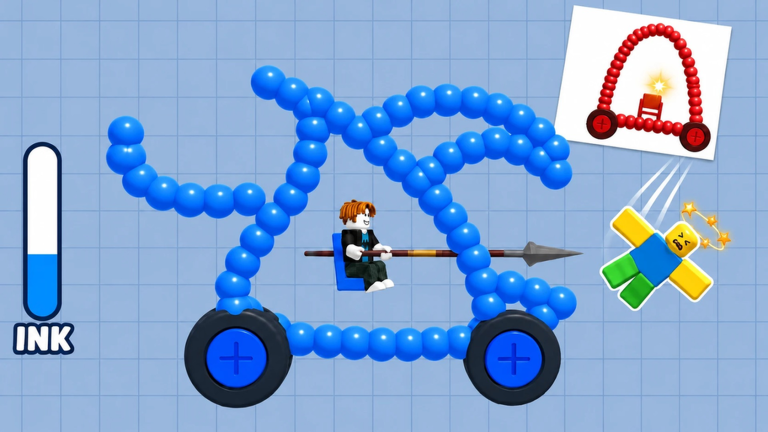
This page ranks weapon archetypes for Draw Your Cart! on Roblox. In this SendyStudios experience you draw the cart, then attach combat tools—spears, axes, cannons, sword-style blades, and creative hybrids—within a limited ink budget. Fights resolve through driving, swiping, knockoffs, part breaks, water hazards, DUEL matches, and a boss challenge every ten wins. The tiers below are community-observed strategic frameworks. They describe how attachment styles tend to perform, not a developer-approved sealed ladder. Your ink upgrades, drawing precision, and platform controls can move any archetype up or down.
Pair this list with the Cart Builds Tier List so the weapon sits on a frame that can actually deliver it. For drawing fundamentals and early progression, use Getting Started and How to Draw. Spend coins via Upgrades. For input details across PC, mobile, console, and tablet, see Controls. Session checklists live on the Tools Hub.
Ranking criteria for attachments
We score archetypes on five axes:
- First-contact power — Does the weapon hit before the opponent’s? Reach weapons dominate open scrapes.
- Finishing reliability — Can it break parts, flip carts, or force knockoffs once you are in range?
- Ink cost — Heavy cannons and multi-blade clusters eat budget that might have protected wheels.
- Mode flexibility — Strong in free-for-all, DUEL, and boss fights—or only in one of them?
- Forgiveness — How badly does a slightly crooked stroke punish you?
Tiers: S default strong, A excellent with practice, B situational, C learning or meme-leaning when ink is scarce.
S tier — default strong attachments
Long spear / lance line
A clean forward spear remains the most consistent opener. It spends modest ink, creates early contact, and pairs with triangle or slim frames. In DUEL, a straight lance forces opponents to respect your front arc. Against bosses, length helps you poke while keeping the rider seat farther from smash zones. Weakness: side swipes and flankers if you have no secondary brace. Keep the shaft thick enough to survive one break attempt.
Angled ram-blade hybrid
A short heavy blade fused into a wedged nose combines knockoff physics with cutting. It shines when you drive into collisions rather than waiting for perfect aim. Ink cost sits between a pure spear and a full axe head. Great for players who fight by steering into the enemy instead of pure swipe timing.
A tier — excellent with good execution
Twin short swords / scissor fronts
Two forward blades or a forked tip create a wider hit corridor. Excellent when your aim is slightly off or when carts bounce unpredictably in six-player chaos. Costs more ink than a single spear. If your ink pool is low, shrink the forks before deleting wheels.
Balanced axe head
Axes reward committed side swings and part-breaking. A compact axe on a reinforced strut can shred decorative enemy parts and open wheel gaps. Axes are less forgiving on thin mounts—mount them close to a triangle joint. Strong versus ornate enemy carts; slightly worse versus ultra-minimal opponents with little to chop.
Controlled cannon / projectile stub
When the fight UI offers a shoot or fire interaction for drawn cannons, a single well-braced barrel can punish camping and create space before contact. Cannons jump toward S-tier once ink upgrades let you keep a full frame underneath. Early accounts often overspend on the barrel and underbuild wheels—treat that as an A-tier trap until upgrades catch up.
B tier — situational picks
Overhead hammer / club
Huge burst when you land the arc, weak when you miss. Hammers eat ink and raise your center of mass, which can flip you near water or after a knock. Use in DUEL if you read the opponent’s path well; avoid as your only tool in crowded six-player lobbies.
Side hooks and catcher arms
Hooks excel at grabbing, spinning, or denying escape angles. They are weaker as primary damage. Best as a secondary attachment beside a spear. High skill ceiling on mobile where precise hook placement is harder.
Multi-cannon novelty stacks
Two or three barrels look intimidating and can melt bosses if every shot connects and your frame survives. Without strong ink upgrades they leave you fragile. Park this in B until your checklist on Tools shows comfortable leftover ink after rider, wheels, and braces.
C tier — learning tools and ink sinks
Tiny decorative spikes only
Spikes with no real reach teach placement but rarely win fights alone. Use them to practice stroke economy, then graduate to a real spear.
Ultra-heavy fantasy piles
Giant multi-weapon sculptures that ignore wheel protection. Fun for screenshots and skins showcases, poor for win streaks and the ten-win boss cadence. Rebuild into an S/A core before serious DUEL.
Rear-only weapons with no forward threat
Pure rear spikes punish chasers but concede first contact. Acceptable as a small insurance piece, not as your whole kit.
How to choose before you draw
- Check your current ink upgrades—more ink unlocks A-tier cannons and twin blades safely.
- Decide the session goal: streak farming favors spears; boss prep favors braced axes or a single reliable cannon on a tough frame.
- Match weapon to frame from Cart Builds—long spears on slim triangles, axes on shield-adjacent mounts, cannons on wide stable bases.
- Leave a reserve stroke budget for emergency wheel braces after the weapon is placed.
- Confirm fight controls on your device via Controls so swipe and fire inputs feel natural.
Synergy notes with cart structure
Weapons do not float in a vacuum. A spear on a disconnected rider fails. An axe on a single hairline strut snaps on first boss hit. Always connect weapon mounts to load-bearing joints, keep wheels guarded, and avoid blocking your own turning radius. When you unlock cosmetic hats, balls, wheels, or flags, equip them after the combat silhouette is finished—cosmetics should never steal structural ink.
Updating your personal meta
After each boss cycle, ask: Did I lose to reach, to breakage, or to ink starvation? Reach losses push you toward longer spears. Breakage losses push you toward thicker mounts and triangles. Ink starvation means you should demote cannons and multi-blades until upgrades improve. Revisit the Tier List Hub overview and the Guides Hub when patches shift physics or unlock new attachment behaviors listed on Updates.
Creativity still matters. If you invent a hybrid that consistently wins your lobby, treat the tiers as a starting vocabulary, not a ban list. Document what ink cost and frame you used so you can rebuild it after a failed experiment.
Recommended loadout paths
| Goal | Primary weapon idea | Frame partner |
|---|---|---|
| Fast early wins | Long spear | Minimal triangle |
| DUEL focus | Angled ram-blade | Slim braced wedge |
| Boss every 10 wins | Braced axe or single cannon | Shield wall or wide base |
| Low ink account | Single short spear | Ultra-minimal efficient cart |
Practice one path for a full quest cycle before hopping between every shiny archetype. Consistency teaches you which losses are skill and which are design.
Frequently Asked Questions
Quick answers for Draw Your Cart players.
Is this an official weapon tier list?
No. It is a community-style framework for attachment archetypes in drawing combat. Balance and ink upgrades can change what feels strongest.
What is the best beginner weapon?
A single long spear or simple forward blade on a stable triangle frame. It teaches reach and ink discipline before you invest in cannons or twin blades.
Do cannons beat spears?
Cannons can outpace spears when you have ink upgrades and a sturdy base. Without that budget, spears usually win because they preserve wheels and rider connections.
Should I run multiple weapons at once?
Only if leftover ink remains after rider, wheels, and braces. One strong primary plus a tiny hook often beats three half-finished tools.